An AI Roll-Up Is Two Hard Jobs —
Most Buyers Staff Them Separately
Finding fragmented owners nobody has indexed, and screening them fast enough that the model still works. Then actually changing how the acquired business does the work. A database stops at the long list. A banker leaves at close. We run the M&A half on the platform and design the operating half alongside it.
The Thesis, and Why Now
The arbitrage is old and the arithmetic is public. What is new is the claim that the margin moves for an operational reason.
Buy fragmented, labour-heavy services businesses at the multiples small businesses trade at. Aggregate them into a platform that trades higher. That half of the thesis has worked, on and off, for thirty years, and it does not need a language model to be true.
The AI claim sits on top of it: that the work inside these businesses — the bookkeeping, the intake, the scheduling, the claims, the tier-one support — is now substantially automatable, so the margin expands for a reason you can point at rather than because a small company was repriced as a large one.
Both halves have to be true, and the second one is the half nobody has staffed.
Businesses Changing Hands
About six million US small and midsize businesses face an ownership transition by 2035, and roughly one million are expected to sell. More than half of owners are already 55 or older.
Of US Businesses Use AI
Adoption at the end of 2025 — and lowest of all in the one-to-forty-nine-employee band, which is the size of very nearly every target on a roll-up's list.
Market Share, Top 100 MSPs
Forty to fifty thousand managed service providers operate in North America and the hundred largest hold under fifteen percent between them. Accounting, home services and dental look much the same.
Sources: McKinsey Institute for Economic Mobility, The Great Ownership Transfer; Federal Reserve Board, Monitoring AI Adoption in the U.S. Economy, April 2026; M&A Signal, 2026 MSP M&A Report.
The distance between a twenty-person target and the buyer acquiring it is the entire thesis. It is also why the work is hard: the businesses worth consolidating are, almost by definition, the ones nobody has written down.
Where a Roll-Up Actually Stalls
Not at the thesis. Every operator we speak to can already describe the sector they want. The programme slows down in four specific places, and none of them are fixed by more conviction.
The Universe Isn't in a Database
A twelve-person bookkeeping firm has no filings, no banker, no CIM and often no website worth scraping. The curated databases were built for companies with a digital footprint — which is precisely the population you are not buying. And the funnel is unforgiving: roughly a thousand first touches per closed deal is the lower-middle-market rule of thumb, against consideration windows that run six to eighteen months.
Diligence Doesn't Scale Down
A conventional quality of earnings takes weeks and five figures. That is fine on one fifty million dollar deal and structurally wrong when the platform has to look at forty four-million dollar ones a year. It is also where deals die: among search-fund acquisitions that fell apart, seventy-nine percent died on diligence findings.
Nothing Carries Between Stages
The sourcing tool does not know what diligence found. Diligence does not feed the model. The model does not feed the hundred-day plan. Add-on fourteen starts from a blank page, run by whoever happens to be free that week — and the fact that you have done thirteen of these shows up nowhere in the work.
The Operating Half Has No Owner
The returns quietly assume AI takes cost out of the businesses you buy. The deal team cannot do that. The operating partner has never built it. And the vendor who sold you the sourcing tool stopped at signing.
Source: Stanford GSB 2026 Search Fund Study, as analysed by Calder Group.
The Combination Is the Point
Most providers do one half. A sourcing database stops at the long list. An M&A platform stops at close. An AI consultancy has never sat in an investment committee and cannot tell you which of forty targets to buy. A banker sells you the deal and leaves.
An AI roll-up is the one strategy where those cannot be different vendors. “What can AI actually do to this P&L” is a diligence question, a pricing question and a hundred-day-plan question at the same time — and you ask it forty times, not once.
The M&A half runs on the platform today: the sector map, sourcing across the open company universe rather than one database's slice of it, a screen applied identically to your four hundredth target and your fourth, a data room read page by page, memos on your letterhead, and an integration plan drafted before close. The operating half is advisory and scoped build, designed alongside the deal rather than handed off after it.
We will not underwrite your margin. We do the work that has to happen for it to exist.
Across two hundred private-capital fund and operating leaders, ninety-five percent said their AI initiatives met or exceeded the original business case. Seven percent had reached enterprise scale, and talent was named as the primary constraint. The deal is not the bottleneck.
Source: FTI Consulting, 2026 Private Equity AI Radar.
Who You Are Actually Buying This From
Atul Tiwary ran M&A at Barracuda Networks under Thoma Bravo, through the company's acquisition by KKR — buy-and-build from the operator's chair — after investment banking at RBC and corporate development at Fortinet.
Kal Kilpi is a two-time M&A software founder and the hands-on engineer shipping this platform. He co-founded Midaxo, founded and sold Vastuu Group, and designed M&A systems for McKinsey, Verizon, HPE, Mercedes-Benz and Philips.
And the honest version of “we know AI operations” is this: we run our own company that way. Two founders, a handful of collaborators, and a fleet of AI agents that research markets, analyse companies and write code around the clock. The platform you are being sold is one of the things they built. More about the team →
Across the Roll-Up Lifecycle
What the platform does on every acquisition — and, said plainly, where each part of it stops.
Sourcing the Tail Nobody Indexed
One thesis, searched across every source at once
Sourcing runs as metasearch rather than a query against a single database. Company websites, Google Maps and street-level imagery, satellite imagery, hiring and job postings, customer reviews, web traffic and local press, alongside an eight-source research engine covering 70M+ companies, 265M+ contacts, SEC filings and thirty years of financials. Every candidate arrives with the source that found it and its identity checked against that source. A target with no website still gets a record — and keeps its history when a domain turns up later.
How the research engine works →
- Plain-English thesis, not a structured query — describe the buy-box the way you would to an associate
- Identity verified against the source that found it — not a name in a spreadsheet
- Website-less targets kept, not discarded — the long tail is the point
- Automatic segmentation of the market you are about to consolidate
Where it stops. It will not produce revenue or EBITDA for a private micro-cap. What it produces is a verified universe, a qualification pass and a prioritised call list. The numbers come from the owner.
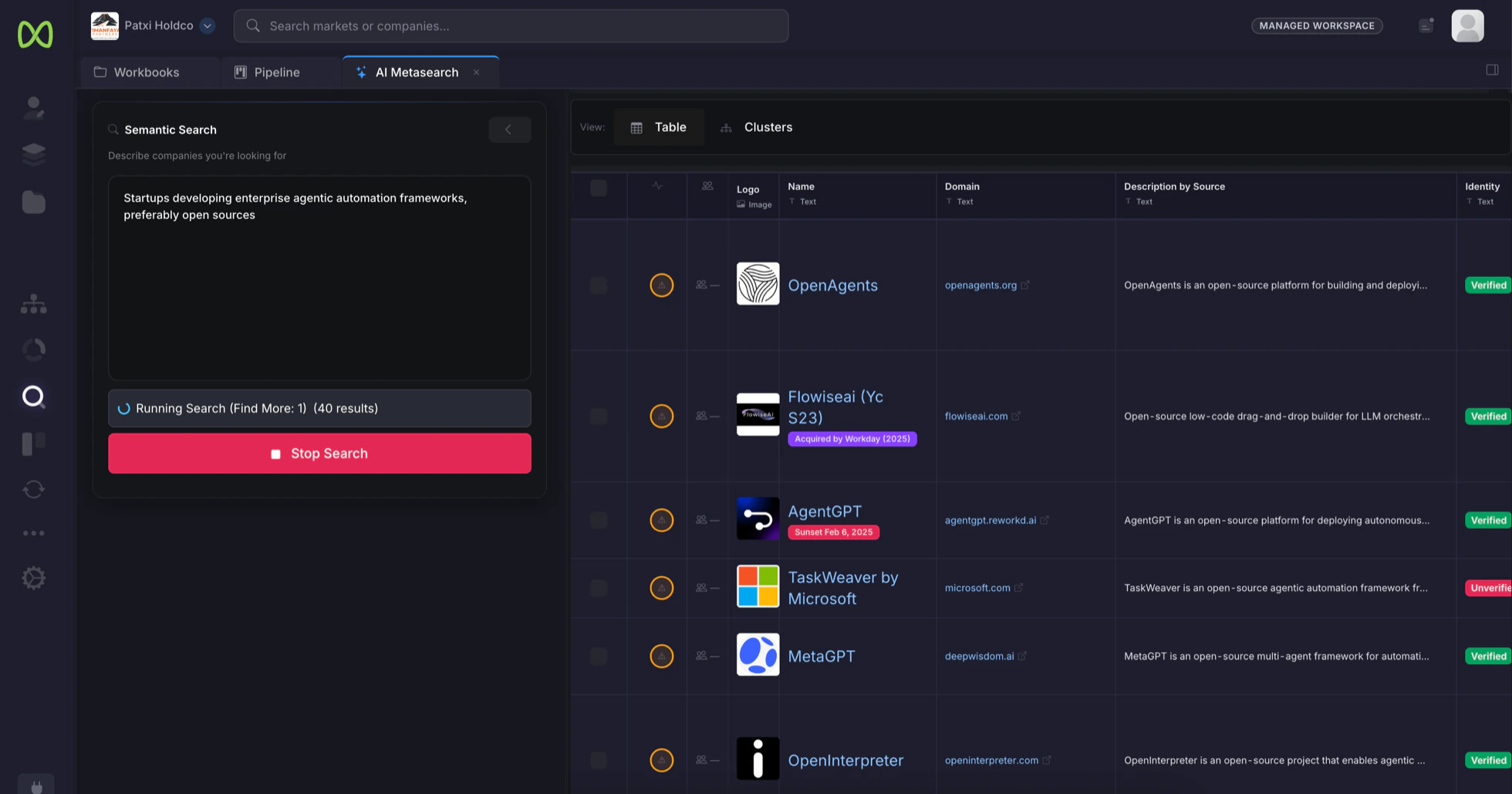

One Screen, Applied Four Hundred Times
Write the buy-box once; every target is assessed against it, with the evidence kept
Criteria, weightings, thresholds and required evidence are defined once and reused across every thesis and every deal team. Add a criterion as a question — owner age, licence type, service mix, route density, whether the work is standardisable — and every company on the list is researched against it and marked qualified or not, with the reasoning sitting in the cell. Missing information never disqualifies a target on its own, which matters a great deal when the businesses you want are the ones nobody bothered to document.
- A reusable screening template with weightings, thresholds and required evidence
- Evidence and source kept behind every score, so the committee can audit the screen
- Test on five rows before you spend on four hundred
- Your 400th target assessed exactly like your 4th — same criteria, same rigour
Where it stops. A screen is a filter, not a judgement. It tells you who to call and why. It does not tell you who to buy.
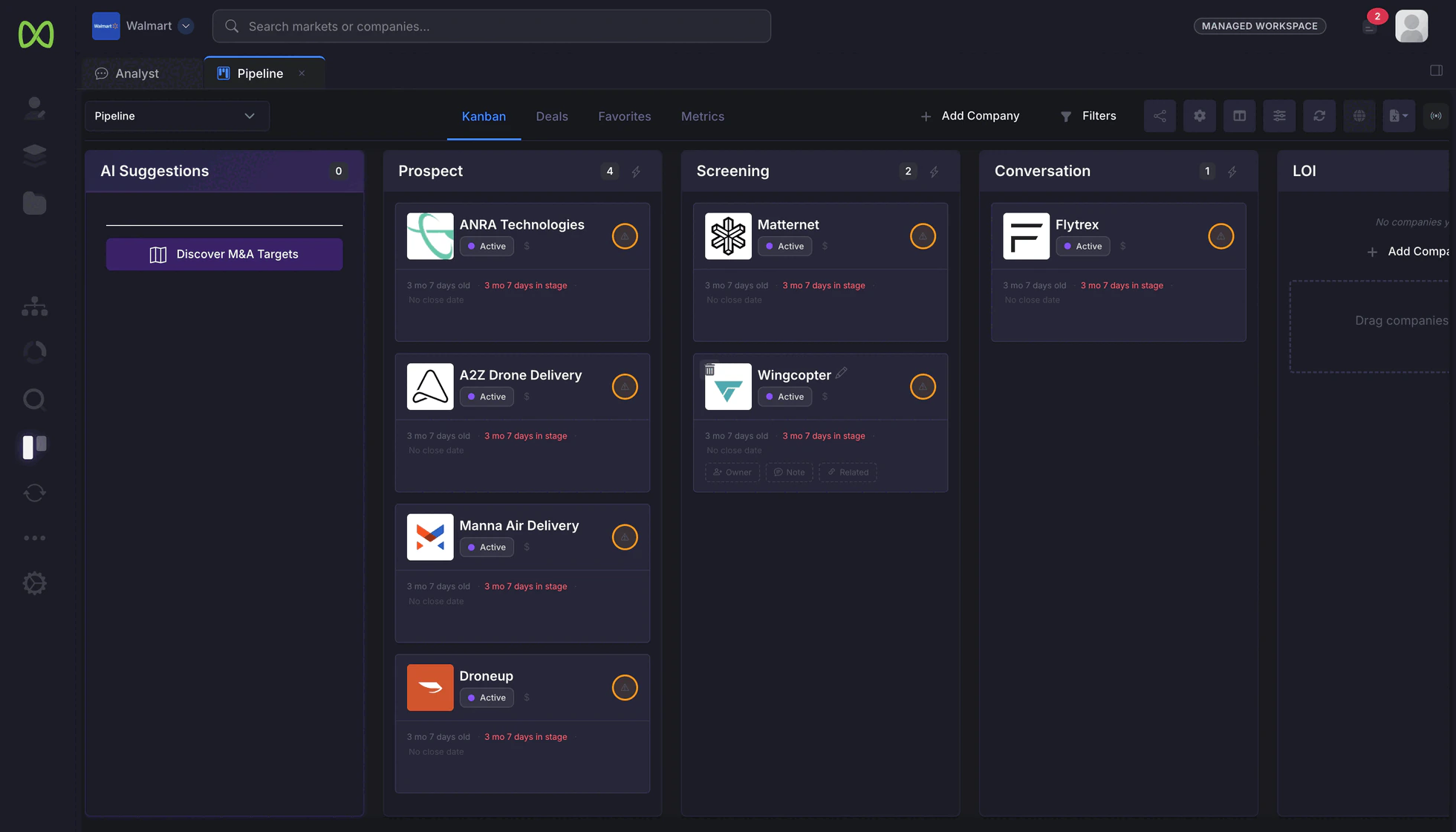
Many Deals in Flight, One Board
The add-on programme in one place — and diligence that survives the paperwork
Pipelines are lists, so the same AI columns work on a sourcing long list and on a live deal board. Cards carry deal value, close date, time in stage and owner; monitoring watches the tail for leadership changes, funding, M&A signals and operational events. When a room opens, documents are rendered and read page by page by a vision model rather than trusted to whatever text layer the PDF happens to carry — which is what a scanned, decade-old, occasionally non-English file cabinet from a thirty-person services business actually requires. Diligence plans, information request lists and workstream checklists come from this deal, not from a template drawer.
- Zero-entry CRM from your Microsoft 365 or Google Workspace mail and calendar
- Scanned and damaged documents recovered, not silently skipped
- Ask the room a question, get the answer with the file it came from
- Nineteen board-ready deliverables, in your template and your branding
Where it stops. No quality of earnings, no audit, no legal or tax opinion, and nothing to do with signing, escrow or funds flow. Licensed professionals still sign those, and a person still decides.

The Integration Plan, Before the Price
Workstreams, governance and a synergy register, drafted before close
The plan a committee approves should be a plan somebody can be held to. Integration playbooks in the same document language the deal was approved in; a governance model with named owners and escalation paths; a Day 1 / 30 / 100 milestone matrix across workstreams; and a synergy register where each item is baselined, owned and tracked against what the memo promised. The AI-driven items sit in that register like everything else — named, owned, measured — rather than as an adjective in the investment case.
- Day 1 / 30 / 100 across every workstream, with dependencies
- A synergy register tied back to the memo, not a fresh spreadsheet
- Exports to PowerPoint, Word, Excel and PDF, in your branding
- One isolated workspace per platform or portfolio company, funded from a single balance
Where it stops. These are planning artefacts. The plan does not execute itself, and the platform does not run the acquired company's operations.
Nine of these deliverables are open on the public site: a sector report built from 161 sources, a four-sheet valuation workbook with 355 linked formulas, a board deck that exports to PowerPoint, and a Day 1 / 30 / 100 integration plan. They come from a demonstration workspace — a Walmart-themed drone-delivery case — produced by the AI Analyst under human direction, and the figures in the deal documents are illustrative. Open the deliverables →
The Operating Half — And Who Actually Does It
This is the section that decides whether the rest of the page is honest.
Everybody selling into this thesis implies they will make AI work inside the company you bought. Almost nobody says who does what. Here is our answer, in the order the work happens.
The plan and the design — us.
An AI operating plan for each acquired business, mapped onto the integration workstreams and into the synergy register, so every item is named, owned and baselined against what the memo said. Written by people who build and run production AI systems rather than by people who advise on them.
The build — scoped case by case.
Configuring the platform's own automations, document ingestion and REST or MCP integrations against the acquired company's systems, we do. Changing their line-of-business software, or anything inside a licensed or regulated workflow, is their vendor, their IT function, or an implementation partner. We would be lying to say otherwise.
Adoption — always your operator.
In a services business the constraint is people changing how they work, and that is carried by the general manager you install. We plan it and instrument it so you can see whether it is actually happening. We do not run their operation.
What We Will Not Do
- We do not drop an engineering team into a portfolio company.
- We do not automate an acquired firm's bookkeeping, claims, dispatch, intake or scheduling. No product of ours does that, and no service of ours pretends to.
- We do not promise a margin number in advance.
- We never contact your targets, your lenders or your board. Every external relationship, presentation and communication stays yours.
This half is advisory and scoped build. It sits with Managed Services and with the Enterprise tier's AI Deployment Advisory, priced to the engagement rather than to a seat: a three-month initial term, then month to month, with a mutual NDA.

Modelling the operating change before you own it — an operating-model comparison produced in the platform, from a demonstration workspace.
The Second Add-On Should Cost Less Than the First
This is the part of a roll-up that compounds, and the part almost nobody instruments.
McKinsey's long-running finding is that programmatic acquirers — the ones choreographing a series of deals around a single theme rather than betting on episodic big transactions — earn roughly two percent more in excess annual shareholder returns and have about a sixty-five percent chance of outperforming their peers. One large acquisition succeeds about half the time.
Programmatic is not a temperament. It is whether the screen, the memo template, the diligence plan and the hundred-day plan are objects in a system, or files on the laptop of whoever happened to run that deal.
Source: McKinsey research, as reported by CFO Dive.
Write the screen once
Criteria, weightings and required evidence become a reusable object. Deal fourteen is assessed against the same buy-box as deal four, with the evidence still attached to every score.
Let the programme keep its own memory
Markets, competitors, targets and the owners you have already spoken to accumulate in the workspace, maintained by recurring agent loops, instead of depending on somebody remembering to write it down.
Run it on a cadence, not on attention
Sourcing sweeps, signal scans and refresh jobs run on a schedule, when a deal enters a stage, or when documents land in the room. A deal that has sat too long raises its hand rather than waiting to be noticed on a Monday.
Reuse the plan that actually worked
The hundred-day plan for the fourth acquisition starts from the third one — the workstreams that mattered, the risks that materialised, the synergy items that landed and the ones that did not.
One workspace per platform, per portfolio company or per deal, hard-isolated from each other and funded from a single balance. The programme compounds; the deals stay separate. The value-creation playbook →
The Case Against This, Stated Fairly
You have heard the pitch. Here is the argument on the other side, which we think is mostly right.
The base rate is bad.
Companies spend more than two trillion dollars a year on acquisitions, and the failure rate sits somewhere between seventy and ninety percent. Bain, writing specifically about buy-and-build, is blunter still: doing it well is not as easy as it looks, and too many attempts founder on bad planning.
Harvard Business Review, “The New M&A Playbook”, 2011; Bain & Company, Global Private Equity Report 2019.
AI has not removed the headcount yet.
Seventy-eight percent of the US labour force works at a firm that has adopted AI — and those firms reported a negligible effect on headcount in 2025 and expect close to none in 2026. The margin story is a forecast, not an observation.
Federal Reserve Bank of Atlanta, Survey of Business Uncertainty.
The market is not paying for it.
Sixty-seven percent of lower-middle-market advisers reported no material impact on valuation from AI; twelve percent saw upside. Whatever you believe about the operating upside, you are not yet buying it at a discount or selling it at a premium.
IBBA & M&A Source, Market Pulse Survey, Q1 2026.
The advantage may be rented.
The same tooling is sold by subscription to every independent firm in the sector. And a good deal of professional-services spend is liability transfer and credentialing rather than output — a board cannot point at a model and say it relied on expert guidance. Services may simply re-commoditise on price.
Better Tomorrow Ventures, “Services Won't Become Software”, February 2026.
We do not sell this thesis and we do not underwrite it. Two things still look defensible.
The first is that the entry arbitrage is old, published and independent of AI. If the operating upside turns out smaller than the market expects, you have still bought better businesses faster, with less adviser spend, and screened a great many more of them. That is just cheaper, better M&A.
The second is that if the upside is real, it is an execution problem: which businesses you buy, at what pace, and whether the transformation plan existed before you signed. That is the part we do.
In Practice
“We've picked the sector. We need the universe, and it isn't in any database.”
The thesis becomes a search that runs across sources rather than a query against one — company websites, maps and street-level imagery, hiring signals, review sites, local press — and each candidate arrives with the source that found it and its identity checked. You define what disqualifies a target once: owner age, licence type, service mix, route density, whether the work is standardisable. Every candidate is then researched against those questions with the evidence attached. What lands is a prioritised call list and a segmentation of the market you are about to consolidate.
“We've signed the LOI. The committee wants the AI plan before it sees the price.”
The diligence plan and information request list come from this deal rather than a template drawer, and the room is read page by page, so a question about customer concentration comes back with the document it came from. Alongside it, the integration plan is drafted before close — workstreams, governance, Day 1 / 30 / 100 — and the AI-driven items sit in a synergy register where each one is named, owned and baselined. The committee approves a plan it can hold you to, not an adjective.
“Third add-on this year. We can't rebuild the analysis every time.”
The screen you wrote for the first deal is an object in the system, so the third target is assessed by the same criteria, in the same way, with the evidence kept behind every score. The memo comes out on your letterhead. The hundred-day plan starts from the one you actually ran, with the workstreams that turned out to matter. And what the programme has learned — the operators, the owners you have spoken to, what broke in the last integration — accumulates in the workspace instead of in one person's folder.
Who This Is Written For
PE Platforms Running an Add-On Programme
Three to ten add-ons a year carried by one to four people — with an investment committee that has started asking what the AI plan does to the model.
Corporates Consolidating an Adjacency
A board-approved services consolidation whose returns assume AI takes cost out of the businesses you buy, and nobody in the building who has ever done that.
AI-Native Holdcos and Studios
You built the AI. The constraint is that one person is sourcing, screening, diligencing and planning the transformation for five businesses at once. Take the M&A half; the architecture is open in both directions.
Search Funds, ETA and Family Offices
You are the banker, the analyst, the diligence team and the incoming CEO — and after close, the person expected to make AI work in a business that still runs on paper.
How to Engage
Three ways in. Most programmes end up on the third.
Run It Yourself
AI Pro at $1,000/mo invoiced annually for a single operator; AI Pro Team at $3,000/mo for three. The AI Analyst agent and workbook, market mapping, company search and analysis, the pipeline board and CRM, target monitoring, presentations and your own templates, with an onboarding session.
- Everything in the lifecycle above
- Isolated workspace per platform or portco
- Financial Modeling and AI Deployment Advisory are Enterprise capabilities
Have Us Run It
Managed Services: you never touch the platform. The workflows, screening criteria, scoring models and templates are configured around your thesis and operated for you. Candidates arrive screened and profiled, memos arrive in your format, and the integration plan is ready before close.
- Three-month initial engagement, then month to month
- Mutual NDA on every engagement
- Your targets and your board stay yours, always
Both — Which Is Usually Right
The judgement stays in-house; the production work does not. Start with one or two stages of the lifecycle — almost always sourcing and screening — and expand as the cadence proves out. The operating-half advisory is scoped alongside it, per acquisition.
- Your team on the platform, ours behind it
- Expand a stage at a time
- AI operating plan scoped per acquired business
The free trial is invitation-only, and automatic acceptance is limited to corporate development teams at companies above $1B in revenue. If you are a holdco, a sponsor-backed platform, a search fund or a family office, book the call instead — it is faster, and we will show you the screen running on your sector.
Questions
Start With the Sector You've Already Picked
Thirty minutes on the thesis, the buy-box, and where the programme is actually stalling — sourcing, screening, diligence, or the plan you owe the committee.