
Building a Corporate Development Function
A corporate development function earns its mandate by improving capital allocation and delivering acquisitions the business can absorb. A busy pipeline and a completed transaction are intermediate outputs. The test is whether the company makes better strategic choices and delivers the value it underwrote.
This guide is an operating blueprint for a substantial company with multiple business leaders, established finance and legal functions, and competing demands on capital. Adapt the authority and cadence to your company; the templates below are proposed management practices, not universal approval policies.
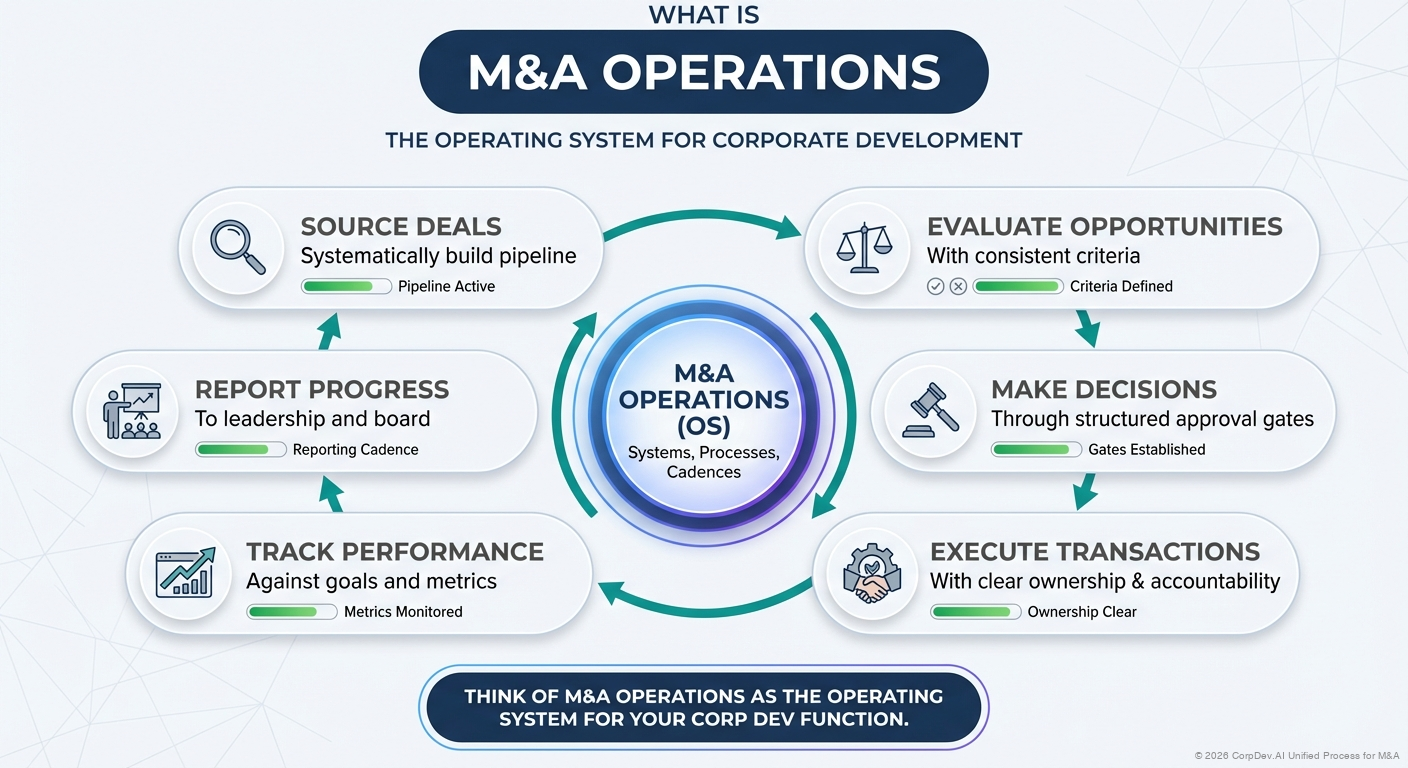 Source deals ↗Evaluate opportunities ↗Make decisions ↗Execute transactions ↗Track performance ↗Report progress ↗Build the operating system ↗Agree the function mandate ↗
Agree the Mandate
Before hiring a large team or launching outreach, agree a short charter with the executive sponsor, CFO, general counsel, and business leaders. Resolve the uncomfortable questions explicitly: who can originate a deal, who can stop it, who commits resources, and who owns the business after close?
| Charter field | Decision to document | Evidence that the mandate is real |
|---|---|---|
| Strategic purpose | Which capabilities, markets, or portfolio changes should M&A deliver? | Named acquisition themes tied to the corporate plan |
| Scope | Acquisitions, divestitures, minority investments, partnerships, or ventures? | In-scope transaction types and explicit exclusions |
| Capital | What capacity can be evaluated and what requires reallocation? | CFO-owned funding assumptions, liquidity constraints, and approval policy |
| Authority | Who approves exploration, indicative terms, binding commitments, and closing? | Delegation of authority agreed with legal and finance |
| Business sponsorship | Who owns the operating thesis and post-close result? | Named executive sponsor and receiving business leader |
| Functional commitments | What support is committed from finance, legal, HR, technology, and operations? | Named leads, allocation, and escalation route |
| Success | How will the function be evaluated? | Decision quality, strategic outcomes, and performance against underwriting |
| Review | When will the mandate be renewed or changed? | Annual strategy review and event-triggered reconsideration |
Charter template: “Corporate development will pursue [themes] to achieve [strategic outcomes], across [transaction types and geographies]. [Executive] sponsors the program. [Business leader] owns the operating case and integration outcome. Capital commitments follow [policy]. Exploration is authorized within [resource envelope]. Exceptions require [approver], a recorded rationale, and a review date.”
The charter is incomplete if the team is expected to source deals but business leaders can decline diligence support indefinitely. Obtain an explicit compact: a sponsor can decline a thesis, but an approved thesis receives agreed resources and timely decisions.
The First 90 Days
The objective is a functioning investment process with an initial portfolio view. Closing an acquisition is not a sensible universal 90-day commitment.
| Period | Work | Deliverable | Acceptance test |
|---|---|---|---|
| Days 1–15 | Interview leadership, business units, functional leads, and owners of past acquisitions | Mandate draft; history of prior deals and unresolved integration obligations | Leadership agrees what M&A should accomplish and what has previously failed |
| Days 16–30 | Translate strategy into acquisition themes; assess build, buy, partner, and divest alternatives | Theme briefs; portfolio gaps; initial capacity assessment | Each theme has a sponsor, economic logic, exclusions, and evidence gaps |
| Days 31–45 | Establish authority, functional coverage, and information handling | Charter; decision calendar; staffing and budget request; information protocol | Legal, finance, and receiving businesses accept their responsibilities |
| Days 46–60 | Build the target universe and screen a limited set against the mandate | Prioritized coverage map; target records; first screening memos | Every active opportunity has an owner, next decision, and credible reason to exist |
| Days 61–75 | Run a real investment review or a retrospective of a prior deal | Decision record; evidence register; model review; integration capacity check | The process produces a clear advance, stop, hold, or rework decision |
| Days 76–90 | Review bottlenecks and establish ongoing reporting | Executive dashboard; next-quarter work plan; corrected operating procedures | Leaders can see capital at risk, resource constraints, and unresolved decisions |
Do not wait for a completed technology implementation. Start with controlled records, named owners, and dependable permissions; automate after the definitions and handoffs work.
Design the Executive Compact
Corporate development coordinates the investment process. It cannot independently validate every technology assumption, accept legal risk, or promise the receiving business will deliver revenue synergies.
- CEO or executive sponsor: owns portfolio direction and resolves conflicts between business units.
- CFO: owns financing capacity, consistency with capital allocation, and the financial control framework. FP&A agrees how performance will be measured after close.
- Business sponsor: signs the operating thesis, confirms integration resources, and owns the acquired business outcome.
- Head of corporate development: owns transaction recommendation, process quality, negotiation coordination, and the record of decisions and assumptions.
- General counsel: leads legal advice, approval formalities, information restrictions, regulatory strategy, and documentation with appropriate specialists.
- Functional leaders: sign off their findings and mitigation commitments. Silence is not acceptance.
- Integration leader: tests executability before binding approval and coordinates Day 1 and subsequent workstreams.
For each material disagreement, record the alternatives, consequence, recommended resolution, and authorized decision maker. A committee discussion without a recorded disposition leaves the team exposed to contradictory instructions.
Resource the Work, Not the Revenue Band
Size the function against overlapping workstreams, complexity, and the available functional bench. Company revenue does not tell you how many cross-border carve-outs, integrations, or minority investments a team can execute.
Build a rolling capacity plan showing each professional’s committed work on sourcing, live transactions, integration, portfolio monitoring, and function management. Estimate demand separately for legal, finance, tax, HR, technology, and operating teams. Include vacations, recurring responsibilities, and an explicit reserve for unplanned work.
Illustrative capacity calculation: Four professionals with 160 planning hours each per month provide 640 gross hours. If recurring management and sourcing consume 240 hours and the team reserves 80 hours for contingencies, 320 hours remain for transaction work. Two live processes requiring 220 hours each create a 120-hour shortfall. Those are planning assumptions, not productivity benchmarks; replace them with your observed workload.
Resolve a shortfall by sequencing work, reducing scope with explicit risk acceptance, borrowing qualified resources, hiring, or adding advisers. Do not solve it by assuming every function can absorb the extra work. See team structure and compensation.
Fund the Whole Function
Separate recurring operating costs from transaction costs and integration investment. Otherwise each deal appears affordable while the shared delivery capability is unfunded.
| Budget | Include | Accountable owner |
|---|---|---|
| Recurring function | Base pay, target bonus, equity expense, benefits, recruiting, data, systems, training, and travel | Head of CorpDev with finance and HR |
| Transaction | Legal, financial, commercial, technical, tax, regulatory, and other specialist diligence; financing and execution costs | Deal lead with finance |
| Integration | Dedicated resources, retention, systems, separation, transition services, restructuring, and change management | Receiving business and integration leader |
| Contingency | Identified downside scenarios, delayed close, extended services, and remediation | Named budget owner under approval policy |
Track incurred, committed, and forecast expenditure separately. A stopped deal consumes resources; record the learning and decision rationale without making sunk cost a reason to proceed.
Maintain an Evidence-to-Decision Register
A good investment memo summarizes a controlled evidence base. It does not replace it. Keep one record of the assumptions that could materially change the decision.
| Field | Example: customer retention thesis |
|---|---|
| Assumption | The combined offering can retain the target’s largest customers |
| Evidence required | Contract-level revenue, renewal dates, change-of-control terms, customer interviews permitted by counsel |
| Owner | Commercial diligence lead |
| Confidence and gap | Management claim; contract and customer evidence pending |
| Economic consequence | Downside revenue and margin scenarios, including retention spending |
| Decision consequence | Reprice, require a condition, change integration scope, or stop |
| Disposition | Approved assumption, unresolved condition, mitigated risk, or rejected thesis |
| Approval record | Decision maker, date, evidence version, and remaining condition |
Use the same identifiers in diligence findings, the financial model, the committee paper, negotiation instructions, and integration initiatives. The objective is to trace a claim to its evidence and to the person accepting the risk.
Establish Information Controls Before Outreach
Agree the protocol with counsel and information security: NDA intake, permitted recipients, target permissions, restricted folders, adviser access, retention, and how access ends. Decide who can authorize customer contact or management interviews.
Competitor transactions may require clean teams and restrictions on competitively sensitive information. Counsel should define permitted exchanges and pre-close conduct; integration planning does not authorize operating the target before closing. Keep legal advice in the appropriate privileged workflow rather than circulating it indiscriminately in a general issue tracker.
For AI tools, confirm the approved environment, access boundaries, retention settings, and treatment of confidential information. Require source traceability and human review of material claims. Generated analysis is not evidence that a diligence question has been answered.
Run a Decision Calendar
Use a weekly team review for blocked decisions and capacity, a regular sponsor review for pipeline priorities, scheduled investment committee slots with an urgent-decision route, and periodic board reporting suited to the mandate. Meeting frequency should reflect the work; adding meetings does not create governance.
Each review should end with a recorded decision, owner, deadline, and next evidence requirement. Circulate substantive papers in time for challenge. Preserve dissent and the conditions attached to approval. See approval gates and board reporting.
Keep the Underwriting Baseline After Close
Freeze the approved investment case and store later forecasts separately. Track the acquired standalone business, synergies, dis-synergies, integration costs, and cash realization without double counting. An initiative’s annualized run rate is different from cash already realized.
At agreed review points, compare actuals and the latest forecast with the original case, explain variance, and assign corrective action. Preserve the original thesis even if reporting lines or executives change. Finance should validate the measurement basis; the business owner remains accountable for delivery.
Test Whether the Function Is Working
At the end of the first quarter, leadership should be able to answer:
- Which acquisition themes deserve capital, and which alternatives were rejected?
- Which opportunities were stopped, and what evidence changed the decision?
- Which live deals have unresolved assumptions or conditions?
- Which functional resources and integration commitments constrain the pipeline?
- What was promised on prior deals, what has materialized, and who is taking corrective action?
If the answers require a scramble through individual inboxes and slide decks, the function needs stronger records and ownership before more transaction volume.
Continue the Work
- Team structure and compensation
- Approval gates and investment process
- Business case development
- Value creation planning
- Reporting and metrics
Establish an AI operating standard
Choose a small set of recurring workflows and evaluate them on representative, permissioned examples: target research, diligence finding extraction, model challenge or committee-material preparation. Define the expected output, supporting evidence and error types that matter for each. Assign ownership for approved data access, evaluation, version changes and correction of downstream records. Keep source documents and the approval record authoritative. Measure the time to a reviewed work product, including rework, before incorporating AI productivity into the capacity plan. See AI in M&A and company digital twins for evidence handling and connected operating models.
© 2026 CorpDev.Ai Unified Process for M&A